Otto

Meet Otto: preparation without surrendering control
A closer look at review-first assistance, connected context, and the agent’s role in every next step.
Useful assistance starts before the action
The most valuable help is not always a task completed without you. Often it is the right information brought together, a draft ready to examine, or a next step made clear. That is the idea behind Otto: preparation that gives the agent a stronger starting point while keeping the decision with the person responsible for the relationship.
From a question to prepared work
In the OttoCan desk, conversation sits alongside client, listing, and deal context. An agent can approach the work as a question rather than a sequence of data-entry screens. The intended rhythm is to bring in relevant context, prepare useful work, and review it before moving forward. A draft is a starting point—not a substitute for checking names, dates, commitments, and tone.
Review is part of the workflow
Consider a follow-up after a buyer conversation. A useful draft should reflect what was actually discussed, avoid unsupported promises, and make the next step easy to understand. Before sending anything, the agent should confirm the recipient, verify property details, remove information that should not be shared, and decide whether the timing is appropriate. Faster preparation should create more room for that judgment, not less.
The same principle applies to bringing data in
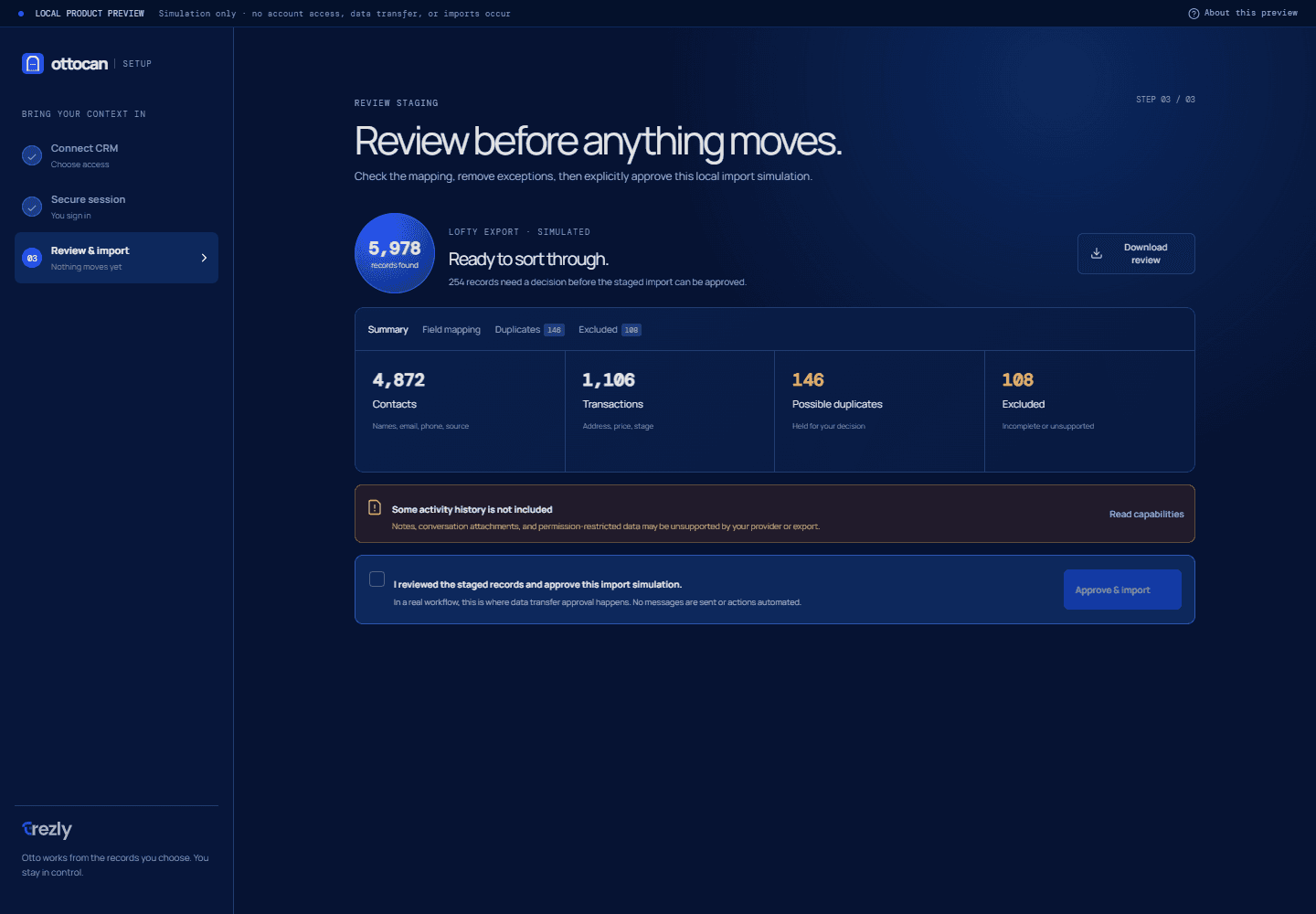
The OttoCan intake preview shows three stages: choosing a CRM, using a temporary browser session, and reviewing the proposed import. The review screen surfaces mappings, possible duplicates, and exclusions before approval. These screens demonstrate a simulated review flow; they do not establish that a live CRM connection or import has taken place.
The relationship stays human
Local knowledge, trust, and accountability cannot be reduced to a generated next step. Otto’s role is to help prepare the work around those relationships. The agent’s role is to decide what is accurate, appropriate, and worth doing. That boundary is what makes review-first assistance different from automation for its own sake.